

Written By: Frances Dellutri, Middle School/Intermediate Level SpacEdge Education Team, April 2016
SpacEdge Topic: Atmosphere, Centripetal Force, Computers, Mathematics, Micro-gravity, Free-fall, Orbital Mechanics, Physics, Satellites, Spacecraft, Weightlessness
Grade (Age) Level: Grades 5-8 (Ages 10-13)
Key Topics Associated with Standards: Collecting, Analyzing and Interpreting Data; Gravitational Interactions; Forces and Motion, Relationship between Energy and Forces
- Teacher: Natalie Orrantia
Topic: Atmosphere, Centripetal Force, Computers, Mathematics, Micro-gravity, Free-fall, Orbital Mechanics, Physics, Satellites, Spacecraft, Weightlessness
Grade (Age) Level: Grades 5-8 (Ages 10-13)
- Teacher: Natalie Orrantia
Classroom grade level appropriate: 5-8
- Teacher: Natalie Orrantia
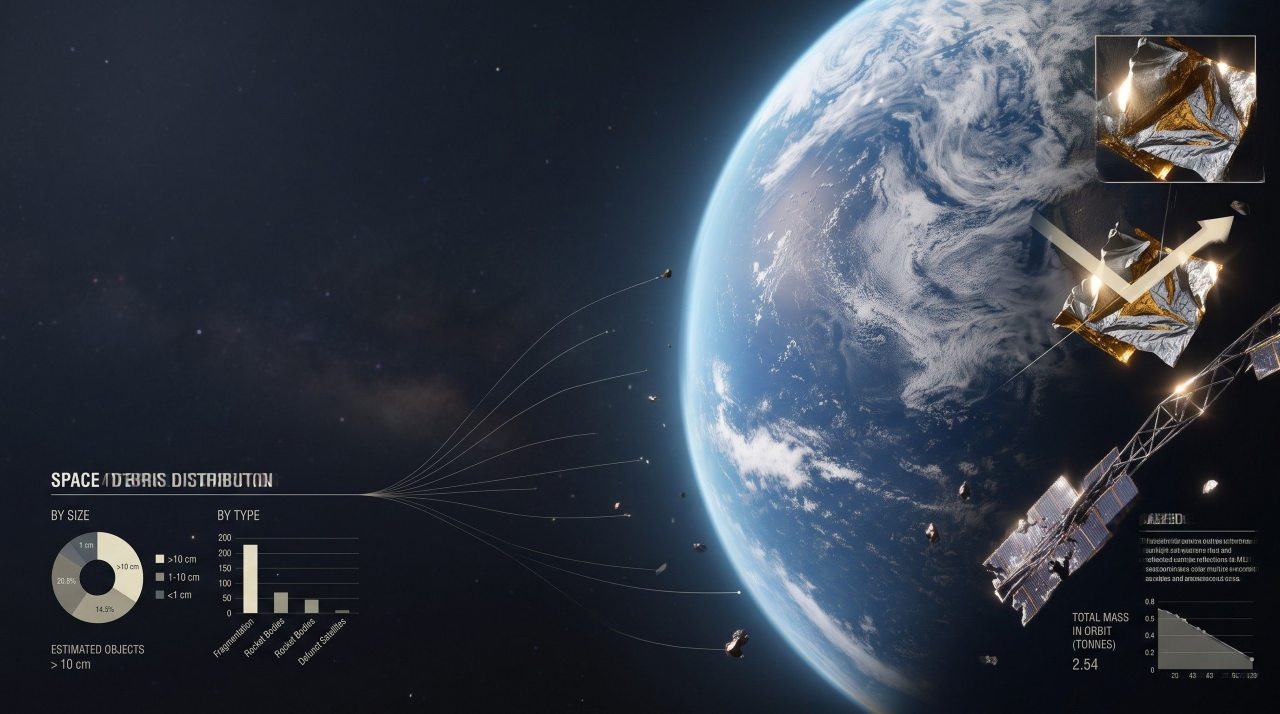
Orbital debris is a looming problem! Space lawmakers are scrambling how to control the space above the earth from manmade objects and then there is the problem of natural objects coming close to or even striking Earth!
This lesson provides an introduction to orbital debris to set the stage. Taking a look at space object sizes, characteristics, and distance from Earth can be greatly defined by using albedo. The concept of albedo (the ability of surfaces to reflect sunlight) is then introduced in an overview of the “Albedo Experiment,” where students will be guided through an experiment to determine the light reflecting from ‘orbiting’ objects. Concepts in this activity illustrate how albedo is employed in the study of space, specifically, in the detection of orbital debris.
When we look at the moon from Earth or the Earth from space, we are seeing reflected light, albedo. Earth is reflecting the sun's light energy and the moon is reflecting light energy from the sun and second hand sun reflection from Earth. Scientists have learned to use albedo in determining the size and shape of space objects that cannot be captured by a camera. The Air Force Phillips Laboratory in Maui, Hawaii uses albedo as one source to conduct measurements to characterize the orbital debris LEO environment. The U.S. Space Surveillance network primarily tracks deep space objects (those with orbital periods greater than 225 minutes) using optical sensors that detect reflected sunlight. The observed brightness of a space object depends on many factors besides its size, such as its orientation, its surface composition and the viewing geometry.
This experiment gives a friendly hands-on demonstration of determining and analyzing albedo and takes into account a space object in a mock revolving orientation.
- Teacher: Natalie Orrantia
